
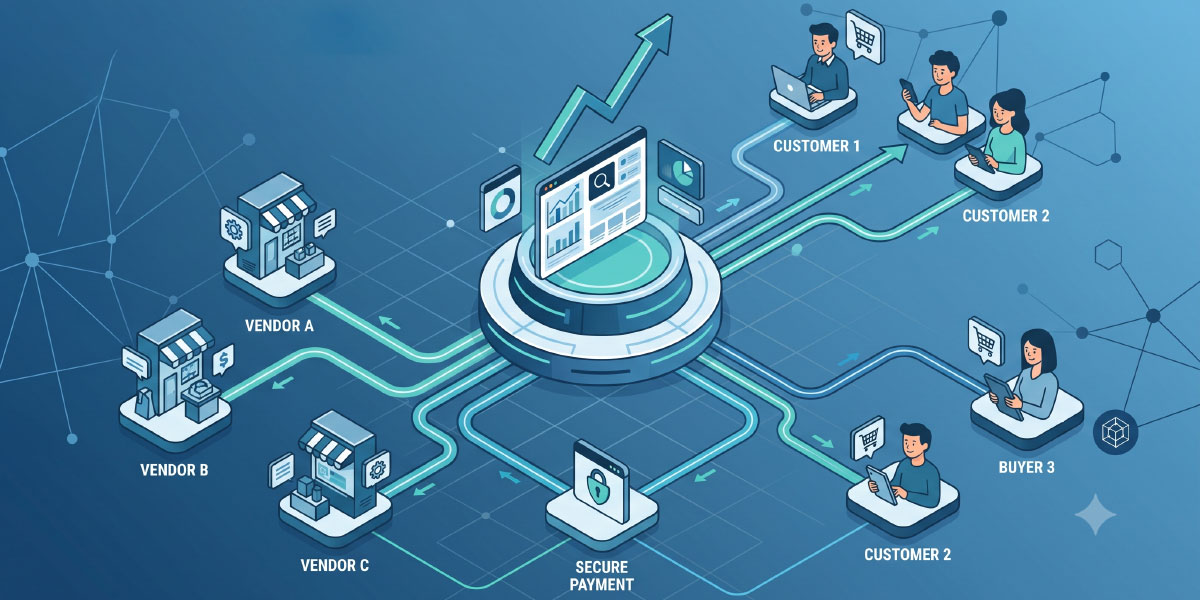
Building a marketplace is one of the most ambitious things a founder can attempt, and also one of the most misunderstood. Unlike a standard ecommerce store where you control the products, pricing, and inventory, a multi-vendor marketplace means managing multiple sellers and multiple catalogs on a single platform that has to work smoothly for everyone at once. Think of platforms like Amazon, Etsy, or Urban Company each one is really a technology layer connecting buyers and sellers, and getting that layer right is far more complex than building a regular online store. If you're a founder considering this path, understanding what actually goes into building and running a marketplace will save you from costly mistakes down the line.
The biggest shift founders need to make mentally is that a marketplace has two customers, not one the buyer and the vendor and both need a platform that works well for their specific needs. A buyer wants a smooth browsing and checkout experience, clear product information, and trust that their order will actually arrive. A vendor wants an easy way to list products, manage inventory, track orders, and get paid on time without chasing the platform for every rupee. Standard ecommerce website development is built around a single store owner controlling everything, whereas marketplace development has to account for dozens or hundreds of independent sellers operating simultaneously, each with their own products, pricing, and shipping rules. This dual-sided complexity is exactly why marketplaces need more thoughtful website development planning from day one rather than being treated as a slightly bigger version of a regular online store.
Before writing a single line of code, founders need clarity on the features that make a marketplace functional rather than just good-looking. Vendor onboarding needs to be simple enough that sellers don't abandon the process halfway, yet thorough enough to verify legitimacy and prevent fraud. A robust catalog system has to let each vendor manage their own listings without interfering with another seller's products. Order management gets significantly more complex too, since a single customer order might involve products from three different vendors, each needing separate fulfillment tracking and separate payouts. Payment splitting is often the part founders underestimate most the platform needs to automatically calculate commissions, hold funds until delivery is confirmed, and release vendor payments on a schedule that keeps sellers happy without exposing the business to unnecessary financial risk. None of this is impossible to build, but it does require experienced web application development rather than a quick template-based setup, since the underlying logic has to handle these moving parts reliably at scale.
Design decisions in a marketplace have to work overtime because they're serving two very different user journeys within the same product. The buyer-facing side needs strong UI/UX design focused on discovery helping people find the right product among potentially thousands of listings from different vendors, with filters, search, and recommendations that actually make sense. The vendor-facing side, often called a seller dashboard, needs a completely different design approach focused on efficiency quick ways to upload products in bulk, track orders, view earnings, and resolve customer issues without needing a manual to figure out where anything is. Founders who treat the vendor dashboard as an afterthought often end up with frustrated sellers who churn off the platform within months, which quietly kills a marketplace's growth even if the buyer experience is excellent.
A marketplace lives or dies on trust, and that trust has to be built into the platform's design rather than added later as a patch. Buyers need visible ratings and reviews for each vendor, clear return and refund policies, and a straightforward way to raise a complaint if something goes wrong. Vendors, meanwhile, need protection from unfair reviews and confidence that the platform won't hold their payments hostage over minor disagreements. Getting this balance wrong in either direction tends to drive one side away, and a marketplace without enough vendors or enough buyers simply doesn't survive, regardless of how well it's coded.
One mistake many founders make is building a marketplace that works fine with ten vendors and a hundred products but falls apart the moment it scales to hundreds of vendors and thousands of listings. Search performance, database structure, and even simple things like category organization need to be planned with scale in mind from the beginning, because rebuilding these foundations later, once real vendors and buyers depend on the platform daily, is far more expensive and disruptive than getting it right the first time. This is also where getting found matters a marketplace with great features but no visibility won't grow, which is why pairing solid development with a proper SEO and digital marketing strategy from launch day onward makes a measurable difference in how quickly a marketplace attracts both its first vendors and its first buyers.
Multi-vendor marketplaces are genuinely complex builds, and founders who try to cut corners with generic templates or inexperienced teams often end up rebuilding significant portions of the platform within the first year. Working with a team that understands the specific challenges of dual-sided platforms payment splitting, vendor management, scalable architecture, and dual-audience design makes the difference between a marketplace that grows smoothly and one that stalls under its own complexity. If you're planning a marketplace and want to make sure the foundation is built right the first time, get in touch with our team and we'll help you map out exactly what your platform needs before development even begins.